Monday, August 19, 2019

The Ultimate Price is Right Strategy Guide: One Wrong Price

One Wrong Price

Rules
Three prizes are shown, each with a price. One of those prices is not the price of the prize it is next to. If the contestant correctly guesses which price is wrong, they win.

Random fact
It's hard to see on TV, but the stand above the prize the contestant chooses lights up. It's very easy to see in the studio.
Win-loss record
  • Actual (seasons 29-46): 195-219 (47.10%)
  • What it would be by random chance: 1/3 (33.33%)
The correct prize to choose was...(seasons 40-46)
  • On the left: 56 playings (30.43%)
  • In the middle: 75 playings (40.76%)
  • On the right: 53 playings (28.80%)
Strategy
Two things that have been true since season 44 can help you here:
  1. There have been no prizes under $1,000 offered in the game.
  2. As PunchABunchFan at golden-road.net pointed out, there haven't been two prizes with the same first digit in their price. For example, there hasn't been a $1,043 prize and a $1,987 prize.
So your strategy starts there. If you see a price of less than $1,000, pick it--it's as good as guaranteed to be the wrong price. Also, if you see two prices with the same first digit, you know one of those prices must be the wrong price.

Beyond that, this game inverts the "pick the endpoints" rule--the center prize is the correct one to choose more often than either the left or the right prize. One the other hand, it's not so much more often that I'd recommend picking the middle as a general strategy; instead, know the price. But if you're clueless, go for the center prize.

Season 49 edit: Both the points above were broken in season 49. There were prizes of value less than $1,000 offered in this game and there were times that two prizes started with the same digit. So sadly, those strategies are no longer as foolproof as they were.

Saturday, August 17, 2019

The Ultimate Price is Right Strategy Guide: 1 Right Price

1 Right Price

Rules
Two prizes are shown as is a price. If the contestant can choose which prize has the given price, they win both prizes.

Random fact
For a long time after this game debuted, it shared its set with Double Prices.

Win-loss record
  • Actual (seasons 29-46): 231-180 (56.20%)
  • What it would be by random chance: 1/2 (50%)
The correct prize to choose was...(seasons 40-46)
  • On the left: 78 playings (48.15%)
  • On the right: 84 playings (52.85%)
  • The more expensive prize: 102 playings (62.96%)
  • The less expensive prize: 58 playings (35.80%)
  • Unknown: 2 playings (1.23%)
Strategy
Mostly know the price, though if you're clueless, pick the prize you think is more expensive.

Friday, August 16, 2019

The Ultimate Price is Right Strategy Guide: One Away

One Away

Rules
A car is shown as is a 5 digit price. None of those numbers is correct; each digit is exactly one away from the correct value of that digit in the car's price. The contestant guesses the price of the car. If they are correct, they win the car; if they are wrong, they are told how many digits they had correct and, as long as they got at least one digit right, they get one more chance to guess the price of the car. If they get it right the second time, they win; otherwise, they lose.

Random fact
In one of the earliest playings of this game, Bob really wanted to hear a little horn during the part of the game the price is supposed to revealed by sliding the bar at the bottom of the prop. See how the staff handles it here:

Win-loss record
  • Actual (seasons 29-46): 149-227 (39.63%)
  • What it would be by random chance: 5/32 (15.63%)
  • What it would be if you know the first digit but choose everything else by random chance: 5/16 (31.25%)
Was the correct choice higher or lower? (seasons 40-46)

   Digit 1      Digit 2      Digit 3      Digit 4      Digit 5
#  L     H      L     H      L     H      L     H      L     H
1 N/A   N/A   61.8% 38.2%  33.3% 66.7%    0%   100%  41.7% 58.3%
2 100%   0%   94.1%  5.9%   80%   20%   66.7% 33.3%   75%   25%
3 98.6% 1.4%   75%   25%   72.7% 27.3%  62.5% 37.5%   50%   50%
4 N/A   N/A   85.7% 14.3%  73.9% 26.1%   68%   32%   91.7%  8.3%
5 N/A   N/A    50%   50%   30.8% 69.2%  45.8% 54.2%   75%   25%
6 0%    100%  42.9% 57.1%  35.7% 64.3%  69.2% 30.8%  35.7% 64.3% 
7 N/A   N/A   28.6% 71.4%   15%   85%   37.5% 62.5%  21.7% 78.3%
8 N/A   N/A   22.9% 77.1%  33.3% 66.7%   50%   50%   63.6% 36.4%
(The left most column above refers to the wrong digit shown at the beginning of the game. N/A means that digit was never an option--in other words, the wrong number for the first digit has never been 1, 4, 5, 7, or 8.)

How often was each combination of higher and lower correct? (seasons 40-46)
  • 5 Lower: 0 playings (0%)
  • 4 Lower, 1 Higher: 5 playings (3.8%)
  • 3 Lower, 2 Higher: 26 playings (19.5%)
  • 2 Lower, 3 Higher: 57 playings (42.9%)
  • 1 Lower, 4 Higher: 45 playings (33.8%)
  • 5 Higher: 0 playings (0%)
 Strategy
There's no over-arching strategy here, but here are some tips to keep in mind:
  1. Don't forget the "no digits repeat except the first two" rule--this rule has been true in every playing of this game in since the middle of season 40.
  2. In general, if you're not sure, lean toward "higher" instead of "lower." You can see that in the last table above--the 1 lower/4 higher combination is right almost twice as often as the 3 lower/2 higher combination. But of course make sure at least one of your guesses is lower.
  3. If the second or third wrong digit is a 2, say lower. 94.1% of the time, that's been the correct guess for the second digit, and it's been right 80% of the time for the third digit.
  4. The fourth digit of the car is never 0. So if you see a 1 there, say higher.
  5. If the last digit is a 4, say lower. That's correct 91.7% of the time. The producers are trying to trap you into thinking the last digit is a 5.
  6. If the last digit is a 6, it's a good bet to be higher, but not quite as automatic as saying lower when the last digit is 4. But guessing higher still avoids the trap of you thinking the last digit is 5 that the producers want you to fall for.

Thursday, August 15, 2019

The Ultimate Price is Right Strategy Guide: Now...or Then

Now...or Then

Rules
A prize is shown. Then 6 grocery items are shown in a circle along with a past month and year. For each grocery item, the contestant must choose if the shown price is the price today or was the price in the month and year shown. If they are correct about 3 adjacent items, they win the main prize.

Random fact
There has been an unwritten rule used in this game for a long time: there are exactly 4 items for which "now" is the correct answer and exactly 2 items for which "then" is the correct answer.

Win-loss rate
  • Actual (seasons 29-46): 139-57 (70.92%)
  • What it would be by random chance: 25/64 (39.06%)
For each product, how often was it "now" or "then"? (seasons 41-46)

                  Now: 16 playings (50%)
                 Then: 16 playings (50%)

Now: 20 playings (68.97%)        Now: 21 playings (63.64%)
Then: 9 playings (31.03%)       Then: 12 playings (36.36%)

Now: 22 playings (68.75%)        Now: 20 playings (68.97%)
Then: 10 playings (31.25%)      Then: 9 playings (31.03%)

                 Now: 25 playings (73.53%)
                 Then: 9 playings (26.47%)

Strategy
Mostly know the prices, but the following can help you:
  1. Keep the unwritten rule in mind. There will be four now's and two then's.
  2. Ask yourself if the product even existed during the "then" timeframe. If it didn't, the correct answer must be "now."
  3. Most importantly: do not jump across the board, especially if you get one wrong. For example, let's say you start at the top and get it wrong. Do NOT go to the bottom product! Yes, you will need to eventually get that one correct. But if you go straight there and get it wrong, the game is over. Instead, go to the first product clockwise from the top. (Or you can go counter-clockwise; direction doesn't matter.) If you get that right, great! If not, you're still in it. And then keep going one at a time in whichever direction you chose. Why? Because you want to find the two "then" products. So give yourself as many chances as possible to find them. If you do find them, you know everything else must be "now."
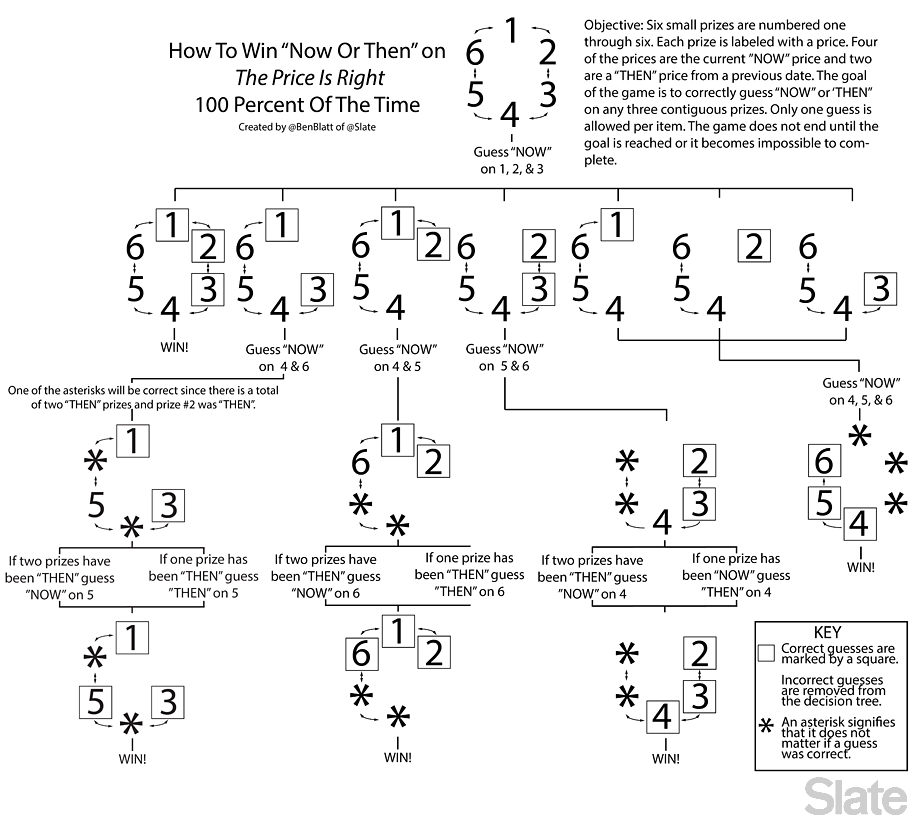
EDIT: As gamesurf at golden-road.net pointed out, the folks at Slate figured out how to win this game 100% of the time as long as there are 4 now's and 2 then's:
131112_CBOX_NowGameDiagram

Wednesday, August 14, 2019

The Ultimate Price is Right Strategy Guide: Most Expen$ive

Most Expen$ive

Rules
Three prizes are shown. The contestant must choose which one is the most expensive prize to win.

Random Fact
They sometimes use the announcer George Gray as one of the models in this game. It usually goes well, but not quite always...

Win-loss record
  • Actual (seasons 29-46): 265-227 (53.86%)
  • What it would be by random chance: 1/3 (33.33%)
The most expensive prize was #...(seasons 40-46)
  • 1: 70 playings (35.71%)
  • 2: 56 playings (28.57%)
  • 3: 70 playings (35.71%)
Strategy
Mostly know the prices. Don't forget the trip rule--if you're playing for three trips, the destination farthest away from LA is very likely to be the most expensive trip. And if you're completely clueless, pick an endpoint (i.e. pick #1 or #3). But this is a know the prices game.

Tuesday, August 13, 2019

The Ultimate Price is Right Strategy Guide: More or Less

More or Less

Rules
3 prizes are shown as is a car. For each prize, a wrong price is shown, and the contestant must guess whether the actual price of the prize is more or less than the wrong price. If they are right, they advance to the next prize; if they are wrong, the game ends but they win any prizes they guessed correctly.

Random fact
This was the last pricing game to premiere while Bob Barker was still hosting. You can see the first playing here:

Win-loss record
  • Actual (seasons 35-46): 25-110 (18.52%)
  • What it would be by random chance: 1/16 (6.25%)
For each prize, the correct choice was...(seasons 40-47)
First prize:
  • More: 55 playings (58.51%)
  • Less: 39 playings (41.49%)
Second prize:
  • More: 42 playings (48.28%)
  • Less: 45 playings (51.72%)
Third prize:
  • More: 22 playings (31.88%)
  • Less: 47 playings (68.12%)
The car:
  • More: 11 playings (23.40%)
  • Less: 36 playings (76.60%)
Of course, for the second prize and later, only playings where the contestant got to that prize are counted.

How often was more or less correct based on the fake price? (seasons 40-47)
(The data below is courtesy of AvsFan on golden-road.net. It only applies to the first three prizes.)

Fake price        More         Less
$0-$999         55 (100%)     0 (0%)
$1,000-$1,499   15 (33%)     30 (67%)
$1,500-$1,999   14 (45%)     17 (55%)
$2,000-$2,499   17 (41%)     24 (59%)
$2,500-$2,999   13 (36%)     23 (64%)
$3,000-$3,499    7 (32%)     15 (68%)
$3,500 and up    0 (0%)      23 (100%)

How often was each combination of more and less correct? (seasons 40-47)
Note: the following statistics only count playings where the contestant reached the car.
  • 4 More: 0 playings (0%)
  • 3 More, 1 Less: 8 playings (18.18%)
  • 2 More, 2 Less: 17 playings (38.64%)
  • 1 More, 3 Less: 19 playings (43.18%)
  • 4 Less: 0 playings (0%)
Strategy
Mostly know the prices, but with a couple of tips:

  • For the first three prizes, you should guess "more" for any fake price of $999 or lower and "less" for any fake price of $3,500 or higher.
  • Note the escalating probabilities of each prize being "less" as the game goes along, so that should be what you lean toward later in the game. 
  • That said, it's never been correct that all four prizes had the same correct choice; in fact, from seasons 40-47, it was only true once that the first three prizes had the same correct choice (again, only counting playings the contestant reached the third prize.)

Monday, August 12, 2019

The Price is Right Ultimate Strategy Guide: Money Game

Money Game

Rules
A car is shown as is a board with 9 pairs of numbers. The middle number of the price of the car is given to the contestant. The contestant must pick the pair of numbers that corresponds to the first two digits of the car and the pair of numbers that corresponds to the last two numbers; they may make up to three wrong guesses. Whether the contestant wins the car or not, they win money equal to the sum of the wrong guesses they made.

Random fact
When Money Game first debuted, it was played on the stage instead of the turntable. You can see a playing here:

Win-loss record
  • Actual (seasons 29-46): 244-292 (45.52%)
  • What it would be by random chance: 1/2 (50%)
    (Note: the above assumes there are three reasonable choices for the first two digits and six reasonable choices for the last two digits. That's a fact that has been true in every playing since at least season 40.)
<voice from offstage> You already know what I'm going to say, right?

Yes, yes, yes. Why is the win rate lower than the random chance win rate? I'm getting there.

Thank you. 

Of the three choices for the first two digits, which was correct? (seasons 40-47)
  • The lowest: 113 playings (52.07%)
  • The middle option: 29 playings (13.36%)
  • The highest: 75 playings (34.56%)
How often was the number in each position a correct choice to make? (seasons 40-47)
21.66%  3.69% 24.42%
20.28% 17.05% 29.49%
25.81% 28.57% 29.03%

Strategy
While there's nothing completely foolproof in this game, here are some tips:
  • Ignore the "digits don't repeat except for the first two" rule. Repeating digits do happen in this game.
  • Start by trying to find the last two digits! No one ever does this, but since you get the money for the wrong choices you make, you might as well start with the larger numbers so you make more money if you're wrong.
  • Speaking of the last two digits, if you see an "el cheapo" (a number less than 10) on the board, pick it. From seasons 40-46, it was a correct choice 57.89% of the time. (Oddly enough, el cheapo was never even an option in season 47. I don't know if that's a trend or a one season oddity.)
  • The number in the top center has been the season number of the show since season 35. (There have been a couple of exceptions, but they've been extremely rare.) The season number hasn't ever been correct more than twice in a season, and more often, it's correct once or not at all. In other words, you should avoid it.
  • For the first two numbers of the price of the car, pick the endpoints applies. As you can see, for the three choices you have for the first two numbers, the middle one is correct less than 1 out of every 7 playings. This is why the win rate is lower than the win rate by random chance--contestants like to pick the middle option for the first two digits and they waste a pick in the process.